Tuesday 25 November
16 Days of Activism 2025: Fighting to End Violence Against Women and Girls with Disability in the Digital Age
The United Nations global 16 Days of Activism to End Gender-based Violence campaign runs from Tuesday 25 November (International Day for the Elimination of Violence Against Women) until Thursday 10 December (International Human Rights Day).
This year’s theme focuses on digital violence. As society’s access and usage of digital technology expands, so do the ways that violence can be carried out or enabled through digital technologies and online spaces.
In Australia, PWDA stands with women and girls with disability, whose experiences of violence are shaped by overlapping forms of discrimination: gender, disability, and sometimes digital accessibility barriers.
Last year we focused on amplifying the voices of women with disability and the intersection of disability and gender based violence.
Here we explore what the 2025 theme means for women and girls with disability, what PWDA is doing to advocate for an end to violence against women and gender diverse people with disability and how everyone can play a part.
The 2025 Theme: “UNiTE to End Digital Violence against All Women and Girls.”
The United Nations theme for 2025 is “UNiTE to End Digital Violence against All Women and Girls.”
Violence against women and girls affects one in three women (WHO, 2021). This year’s theme turns a spotlight on one of the fastest-growing forms of abuse; digital violence against women and girls.
The 2025 theme focuses on:
- recognising that digital violence is gender-based violence
- working towards technology as a means to reduce harm rather than increase it
- strengthening inclusive, accessible service responses
- promoting laws, policies and education that address online violence in all its forms.
For women and girls with disability, this means making sure digital safety tools, reporting systems, and online services are inclusive and accessible for them to use.
Digital abuse (also known as technology-facilitated violence) covers a wide spectrum of behaviours including image-based and deep fake abuse, online harassment, violent pornography, online grooming, doxxing, identity theft and technology-based abuse (using technology to stalk, monitor or harass you) to name a few.
This year’s campaign is a reminder that digital safety is central to gender equality.
We all know that online spaces can feel like a double-edged sword. While they often create greater opportunity for people to find others with the same disability and access community that you may not find in person. However, there is an anonymity that these online spaces offer that can also create an increased opportunity for violence and abuse.
Ask any woman in the public eye and the horrific stories of abuse they often face. One in four female journalists and one in three female parliamentarians report online threats of violence and death threats.
Read more at UN Women ‘What every woman and girl should know’.
Why Digital Violence Matters for Women and Girls with Disability
Women with disability are already disproportionately impacted by domestic, family and sexual violence. Digital violence adds an extra layer, including cyber-stalking, image-based abuse, coercive control through devices, inaccessible reporting tools, and online harassment.
These risks sit alongside structural barriers including limited digital accessibility, fewer safe reporting pathways, and restricted access to digital literacy supports. The digital divide itself is a form of inequality.
Some women with disability, particularly young people with disability, rely on digital tools and social media to connect with like-minded people despite the increased risk of abuse. eSafety Commissioner revealed findings that particularly young people with disability use the internet in greater than average numbers to meet people, share hobbies, and ask questions they wouldn’t feel comfortable to do so in-person.
This year’s theme pushes us to ensure digital spaces are not left out of violence-prevention efforts and that disability inclusion sits at the centre of every solution.
Everyone deserves to feel safe and included in all spaces, including online.
How PWDA advocated against gender-based violence in 2025
PWDA has a variety of projects pushing for change this year including:
- Supporting Accessible DFV Services
PWDA’s Building Access project continued across NSW, supporting DFV services to improve accessibility for women with disability. The 2025 program delivered full-day, peer-led training across regional NSW—including Illawarra, Shoalhaven, Orange, Lake Macquarie, Campbelltown and Port Macquarie.
Facilitated by women with lived experience of both disability and DFV, the sessions focused on practical strategies to remove barriers in service delivery. Participant feedback was extremely positive, with many reflecting on the power of learning directly from lived experience and the impact this had on their own practice.
As project lead Shannon Welch noted, the peer-led model created trust, relatability and more inclusive outcomes—highlighting its potential as a national approach.
This work directly complements the fight to address digital violence, as more services shift to online tools, helplines and digital interfaces. Accessibility in digital spaces is just as critical as accessibility in physical ones. - Improving Healthy Relationships: A Pathway to Primary Prevention
PWDA’s new Healthy Relationships project shifts the focus toward primary prevention for people with disability themselves. This multi-year initiative strengthens skills to recognise and respond to early signs of unhealthy or abusive relationships while building sector capacity for disability-inclusive prevention practice.
With co-design and peer leadership embedded throughout, the project ensures that lived experience shapes every stage—from content creation to future pilot delivery in 2026. This rights-based approach is vital for digital spaces too, where early signs of coercion or abuse can appear long before physical violence does. - Advocating for safer workplaces
The Advancing Women mentoring program continued its impact in 2025 expanding past pilot stage, new mentors and mentees coming on board and the Leading Inclusively workshop held in Brisbane.
Participants from across the disability and broader community sectors explored leadership, diversity, inclusion, and self-advocacy.- Key insights highlighted the importance of:
- meaningful representation of women with disability in leadership roles;
- strong, supportive organisational structures;
- deep listening at all levels of influence;
- ongoing education across workplaces.
- These principles also apply to digital safety: leadership, representation and inclusive systems are essential to creating safer digital environments.
- Conversations that Count podcast
PWDA’s Project Manager Summah joined Domestic Violence NSW podcast ‘Conversations that Count’ in August. They explored the complex and deeply entrenched power imbalances that victim-survivors with disability face, and how these impact their safety, autonomy, and access to justice. Listen to ‘PWDA on coercive control’. - SAFETY EXIT Button
In 2025, PWDA introduced a Safety Exit Button on our website to enable a quick and easy way to close the page.
Clicking the blue EXIT button (see below) on the bottom left-hand side of the page will immediately close the current web page and send you to a neutral webpage if an abuser or someone monitoring your computer enters the room.
Adding a Disability Lens to the Domestic Violence Lived Experience Advisory Network
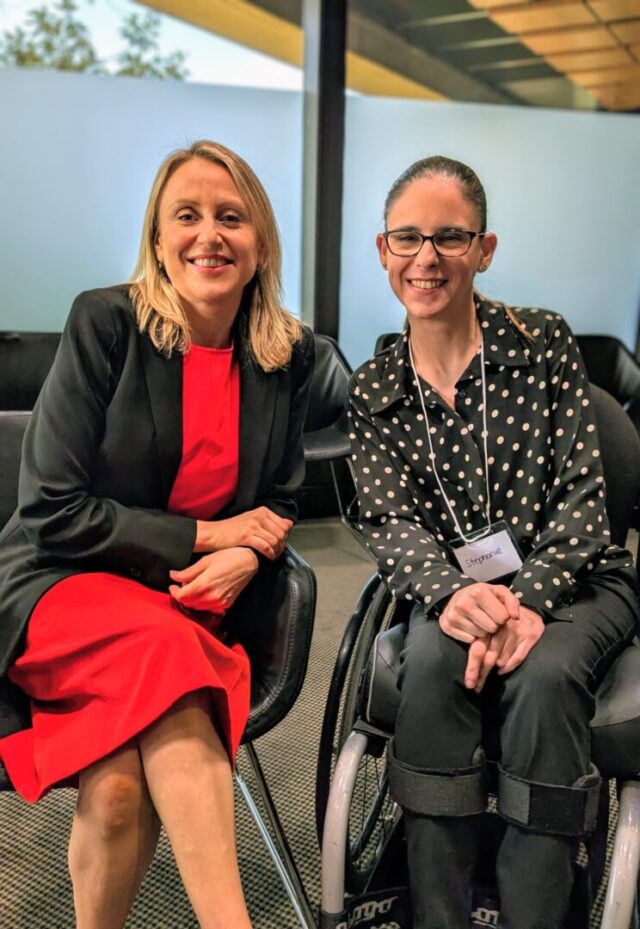
PWDA Board Director, Steph Travers attended the Domestic Violence Lived Experience Advisory Network Morning Tea Panel on Thursday 20 November at NSW Parliament House. Steph has been adding a disability lens to NSW Women’s Safety Commissioner Strategy work as part of the advisory network.
Steph met with the NSW Women’s Safety Commissioner, Dr Hannah Tonkin who facilitated the panel and seated at the same roundtable. They discussed the risk of coercive control in care settings and relationships, intersectional disadvantage in accessing and navigating the justice system, and the need to increase resources for people with disability in those systems.
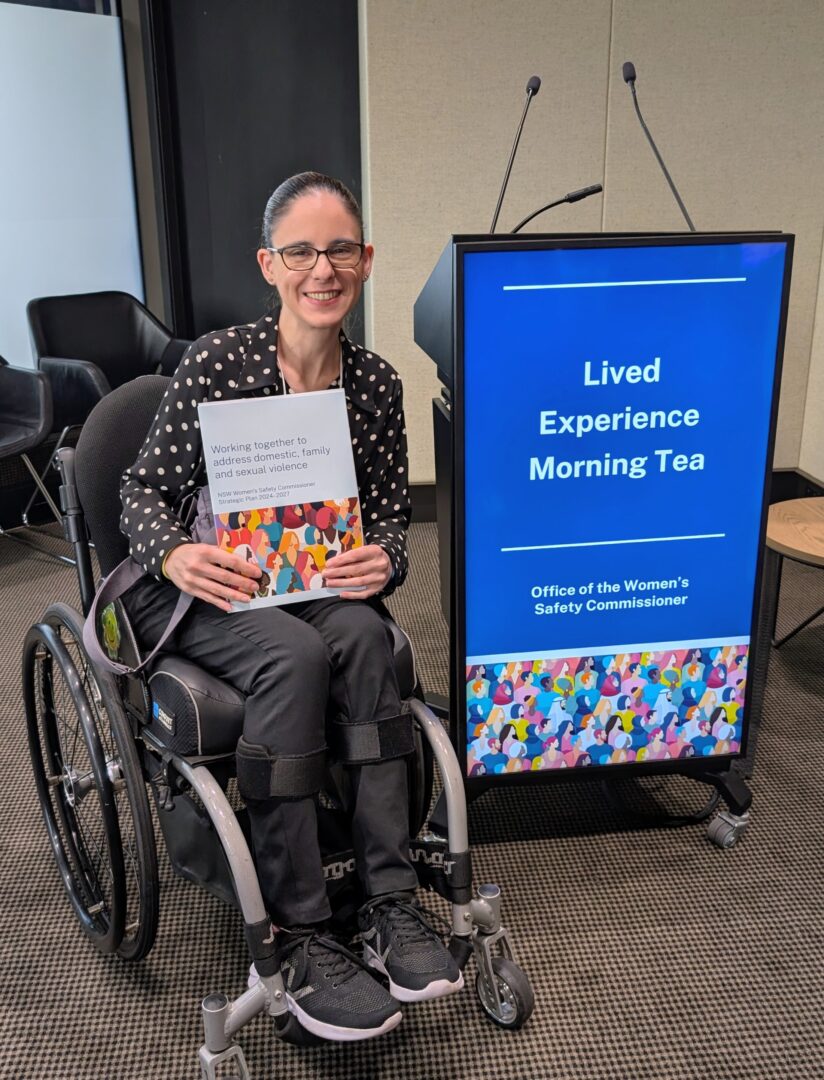
The insightful panel discussion covered the toll of DV advocacy, navigating the media, self care, resilience and amplifying voices of lived experience to guide change.
How to continue to create change?
Digital violence is real and rising. For women and girls with disability, it intersects with existing forms of inequality and discrimination. The 2025 campaign is a reminder that safety must extend to every environment—including online ones.
PWDA recommits to ensuring digital spaces are safe and advocating for change that addresses intersectional risks of violence.
PWDA will continue championing lived experience leadership, building capacity in services, and strengthening the rights, skills and visibility of women and girls with disability across Australia.
Together, we can create digital spaces that are safe, inclusive and empowering and not places of harm.
How you can get involved
- Use accessible campaign materials: Make sure your organisation uses social media tiles, graphics, videos in accessible formats (alt text, captions, plain language etc).
- Make your digital environments safe-by-design: If you host forums, apps or platforms, audit for accessibility and safety features (reporting functions, moderation, privacy support, etc).
- Engage your networks: Encourage workplaces, community groups, family, friends to talk about digital violence and its impact on women and girls with disability.
- Safe. Everywhere. Always. is a free challenge open to everyone being run by UN Women Australia. The challenge is to complete 30, 60 or 100kms any way you want from 25 November to 10 December. You can walk, run, swim or roll your way through the 16 days!
For more information on PWDA’s work or to get involved, visit People with Disability Australia.
CRISIS SUPPORT NUMBERS
If you or someone you know is in danger or needs support, please contact one the following crisis services:
- Emergency 000
- 1800RESPECT 1800 737 732
- Lifeline 13 11 14
- Kids Helpline 1800 55 1800
- MensLine 1300 78 99 78
- Q Life (Anonymous LGBTIQA+ support and referral) 1800 184 527
- 13YARN 13 92 76
Ends | Contact us