What the 2026 NDIS law changes mean and what happens next
Current as at 1 October 2026
On this page:
The Australian Parliament has passed new laws that will make significant changes to the National Disability Insurance Scheme (NDIS).
The changes will affect:
- how people access the NDIS
- how NDIS plans are made and reviewed
- how some NDIS decisions and administrative processes are made.
- how some providers operate
- how some types of funding are calculated
Most of these changes will not happen straight away.
On 20 August the Bill received Royal Assent. This means the Governor-General formally approves it to becomes law.
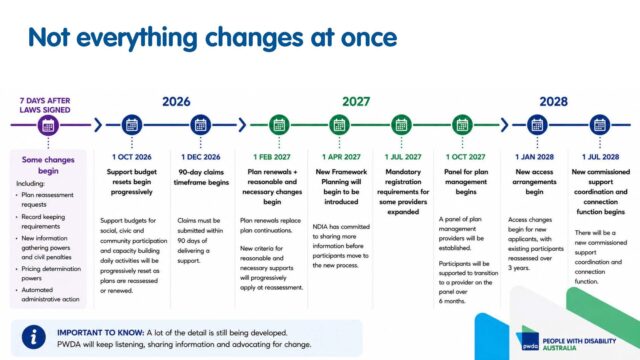
The first changes will start 7 days after Royal Assent on 27 August 2026. Other changes will be introduced gradually between 2026 and 2028, with some transition arrangements continuing until the end of 2030.
What do I need to do now?
For most NDIS participants, you do not need to do anything differently right now.
You can continue to use your current NDIS plan and supports as usual.
The NDIA has said it will let participants know before changes that affect them are introduced.
People applying to the NDIS can also continue to apply under the current access process until 1 January 2028.
It is important to remember that plans can still change through the usual NDIS planning processes. A change to someone’s plan does not necessarily mean it has happened because of the new laws.
If something does not seem right
The NDIS changes will start at different times. If you think a change has been applied to you too early or in a way that does not seem right, there are things you can do.
Ask what is happening
If the NDIA contacts you about your plan, you can ask what the contact is about.
If they have not told you whether it is about a plan renewal, reassessment, variation or something else, ask them to explain:
- why they are contacting you
- what process is happening
- what, if anything, could change.
You can also ask for information in a way that is accessible to you and involve a support person if you need one.
You can also ask what the NDIA needs from you and whether there is a deadline. Ask for important information in writing if that helps you understand what is happening.
Tell PWDA what happened
If you think one of the new changes has been applied before it is meant to start, or you are concerned about how a change has been applied, PWDA wants to hear from you.
You can tell us what happened through our NDIS changes feedback form.
We will use the information people share with us to understand how the changes are being implemented and identify issues we need to raise in our advocacy. Filling in this form does not mean you will receive a response and it should not be used to request support.
You may be able to ask for a decision to be reviewed
If the NDIA has made a decision you do not agree with, you may also be able to ask for the decision to be reviewed.
Many NDIS decisions can be reviewed, including decisions about:
- the supports funded in your plan
- changing your plan
- refusing a plan reassessment
- refusing a plan variation
- NDIS access.
For most reviewable decisions, you need to ask for an internal review within 3 months of receiving the decision in writing.
If you need help understanding your rights or finding advocacy support, the Disability Gateway (1800 643 787) can help connect you with disability advocacy services.
You can also read the NDIA’s Guide to Decision Reviews.
What changes are coming?
7 days after the new law receives Royal Assent
Some changes will begin 7 days after Royal Assent.
Asking for a plan reassessment
Only a participant, their plan nominee or a child representative will be able to ask the NDIA for an unscheduled plan reassessment.
A child representative is usually a parent or another person who makes NDIS decisions for a child under 18.
You will still be able to ask for a reassessment if there has been a significant and ongoing change to:
- your functional capacity and support needs
- where or how you live
- your education
- your work
- the informal support you receive from family, friends or others.
If the NDIA does not make a decision about your request within 90 days, the request will be treated as refused. This means you will be able to use your review rights rather than waiting indefinitely for a decision.
You will still be able to ask for a plan variation if there is an emergency, crisis or short-term change in your support needs.
From 1 October 2026, if you ask for a reassessment and the NDIA agrees, the new funding reductions can apply when your reassessed plan starts. See “From 1 October 2026″ below.
Keeping records
Participants and plan managers will need to keep records about NDIS support payments for 3 years.
Nominees will need to keep records for 5 years.
Providers will need to keep relevant records for 7 years.
The detailed NDIS rules about exactly what records people will need to keep are still to be finalised.
There are also new safeguards around debts. For example, the NDIA will need to tell a participant why it believes a debt exists and give them an opportunity to respond.
Participants and providers will also be able to provide other evidence that a service was received if they have not kept a record in the required format.
Fraud, compliance and provider regulation
The NDIA will have stronger powers to investigate fraud and non-compliance and to ask for information.
There are also new offences and penalties aimed at fraudulent or exploitative behaviour, including some provider kickbacks and inducements.
NDIS pricing
The Minister for Disability and the NDIS will become responsible for making NDIS pricing determinations.
The NDIA will continue to undertake pricing analysis and provide advice to the Minister.
There is no immediate change to NDIS prices because of this change.
The latest review is the Annual Pricing Review for 2026–27 prices. It provides the NDIA’s current guidance about NDIS prices and informed the pricing schedule that took effect from 1 July 2026.
Use of automated systems
The NDIA will be able to use computer systems for some administrative actions, such as processing claims and payments.
The law after amendments includes some safeguards.
The Government says:
- matters requiring judgement must be referred to a human decision-maker
- automated systems can only be used for decisions based on clear and objective rules
- automated actions must have human oversight
- participants will keep their review rights
- the NDIA will need to publish information about its use of automated systems.
How some systems are going to work is still to be decided.
PWDA is advocating for human oversight and accessible review processes as systems are introduced.
From 1 October 2026
Read NDIS funding reductions from 1 October 2026: What you need to know for more detail.
Changes to some support budgets
These changes will happen progressively as plans are reassessed or renewed.
From 1 October 2026, reductions to funding for some NDIS supports have started to be introduced:
- Social, civic and community participation supports: affected budget allocations are reduced by 50%.
- Capacity building daily activities supports: affected budget allocations are reduced by 10%.
This does not mean everyone’s NDIS plan changed on 1 October. The reductions are being introduced over 12 months. If your current plan has not been reassessed or renewed, you can keep using your current plan and supports until it is.
You may see different names for these supports in the new NDIS laws and Government information. Social, civic and community participation may be called assistance with social, economic and community participation. Capacity building daily activities may be called improved daily living skills.
From 1 October 2026, they will begin to apply when a participant receives a new plan or has their plan reassessed. From 1 February 2027, they will also apply through the new plan renewal process.
The Government says this transition will happen over about 12 months.
A 50 per cent or 10 per cent reduction in the budget allocation does not necessarily mean every participant will spend exactly 50 per cent or 10 per cent less. This will depend partly on how much of the existing allocation a person was using and how this budget interacts with some of the safeguards that were secured through amendments.
These are significant changes.
Tell PWDA what happens to your plan
PWDA wants to hear directly from people affected by these changes.
If your plan is reassessed or renewed and your funding for these supports changes, you can tell us what happened through our NDIS changes feedback form.
This form is for feedback only. It is not a way to request individual advocacy or one-to-one support, and you may not receive a response from PWDA.
We want to know things like:
- how much your funding changed
- what support changed
- what explanation you were given
- whether you were able to have your individual circumstances considered
- what the change means for your independence, participation, work, relationships or daily life.
We will use this information to monitor the impact of the changes and inform our advocacy with Government and the NDIA.
If you disagree with a decision about the supports funded in your plan, you may also have the right to ask for the decision to be reviewed.
Supports protected from these reductions
The Government says the reductions will not apply to budgets for critical supports including:
- home and vehicle modifications
- supports in the home, such as help with eating, drinking, dressing, toileting, laundry, cleaning, community nursing care and medication
- personal mobility equipment and transport
- consumable products for needs such as incontinence and menstruation
- Specialist Disability Accommodation.
Other amendments also protect some supports including employment supports, disability-related health supports, high-intensity supports, complex behaviour supports, and some customised and wearable technology and hearing supports.
The NDIA will check whether your plan includes excluded supports when the reduction is applied. The Department says you do not need to provide extra information for this. You may still want to know which of your supports are excluded, so you can check your new plan and ask questions if something does not look right.
Extra protection for people who need continuous 24-hour support
If the funding reduction leaves you without enough funding to safely maintain your 24-hour disability supports, you may be able to ask the NDIA for a plan variation.
To be eligible, you must:
- receive NDIS-funded disability supports throughout the day and night for your disability-related support needs
- have at least $215,030 across specified support budgets before the reduction is applied.
If approved, additional funding can be added to your Assistance with Daily Living or Home and Living supports. This does not restore the funding removed from your social, civic and community participation or capacity building daily activities budgets.
You generally need to ask for the variation within 90 days of the reduction being applied to your plan.
There may be a gap before additional funding is available. The NDIA has up to 21 days to decide whether you are eligible for this pathway. If you are, it has up to another 21 days to decide whether to vary your plan.
PWDA is concerned about what happens if someone does not have enough funding to safely maintain their supports while they wait. Current Government information does not clearly explain whether interim funding will be available.
If the reduction creates an immediate gap in your essential disability supports, contact the NDIA and consider seeking advocacy or other independent support as soon as possible.
There are specific review rights for decisions made through this pathway.
Plans may be suspended in limited circumstances
The NDIA will have a new power to suspend a plan if a participant does not respond adequately to requests for information after reasonable attempts have been made to contact them.
PWDA has already heard concerning examples of people receiving unexpected contact from the NDIA, or contact that may not take account of their communication and accessibility needs.
We want to hear about your experience.
You can use our NDIS changes feedback form to tell us:
- how the NDIA contacted you
- whether you understood why they were contacting you
- whether you were given enough time to respond
- whether your communication and accessibility needs were respected
- whether you were able to have a support person involved if you needed one.
From 1 December 2026
A 90-day deadline for claims
Participants and plan managers will need to make claims within 90 days of the support being delivered.
This will be particularly important for self-managed participants, plan managers and providers.
From 1 February 2027
Plan renewals
A new process called plan renewal will begin.
When a plan reaches its reassessment date, the NDIA may either reassess the plan or create a renewed plan.
A renewed plan will have the same level of supports the participant was previously assessed for, adjusted for current prices.
Plan renewals will replace the process often called a plan continuation.
Any money left over in the previous plan will not carry over into the renewed plan.
From 1 February 2027, the social, civic and community participation and capacity building daily activities reductions will also apply when plans are renewed. If your plan has affected funding and has not been created or reassessed since 1 October 2026, the Government says it will be renewed by 30 September 2027. The NDIA says it will contact participants 60 days before a plan renewal.
Changes to reasonable and necessary decisions
There will also be new considerations for deciding what supports are reasonable and necessary.
The NDIA will be required to consider:
- equity between participants
- the sustainability of the NDIS
- the circumstances of participants with similar needs.
This means the NDIA will have to consider the broader sustainability of the Scheme, as well as a person’s individual circumstances, when deciding what supports are reasonable and necessary.
PWDA will closely monitor how this affects individual planning decisions.
People with similar disabilities can have very different lives, circumstances and support needs. Decisions about reasonable and necessary supports must continue to recognise each person’s individual disability, circumstances, goals and support needs.
Support from parents, families and other informal supporters
The final amendments added more detail about the support parents and families can reasonably be expected to provide.
The NDIA may consider things such as supervision, personal care, transport, emotional support and behavioural support that parents would ordinarily provide.
Importantly, this does not include the additional support a child needs because of their disability compared with another child of a similar age without disability.
The NDIA must also consider the risk of harm to informal supporters, family relationships and informal support networks if NDIS support is not funded.
From 1 April 2027
A new way of making NDIS plans
The NDIA will begin gradually moving participants to a new planning process called new framework planning.
Under this process, a support needs assessment will be used to help determine a participant’s budget.
The Government says participants will spend time with a trained NDIS assessor who will conduct a semi-structured interview about their support needs.
Participants will receive a support needs assessment report explaining how their budget was decided.
This change will not happen to everyone at once.
Participants will progressively move to new framework plans between 1 April 2027 and 31 December 2030.
There are still important details about how the new planning process will work.
PWDA is advocating for support needs assessments to:
- work for people with all kinds of disability
- be accessible
- properly recognise fluctuating, episodic and non-apparent disability
- take account of people’s real lives and environments
- accurately identify support needs
- not underestimate the level of support a person needs.
From 1 July 2027
More providers will need to be registered
Mandatory NDIS provider registration will be expanded for some higher-risk supports.
This may include:
- personal care
- daily living supports
- supports provided in closed settings.
People receiving these supports will need to use a registered provider for those supports.
People will still be able to choose unregistered providers for lower-risk supports.
The rollout of these requirements is expected to continue until the end of 2030.
From 1 October 2027
Changes to plan management
The Government plans to establish a panel of plan management providers.
Participants who use a plan manager will need to choose a provider from this panel.
If their current plan manager is not on the panel, the Government says participants will have 6 months to transition to another provider.
Participants who are eligible for plan management will still be able to have plan management funding included in their plan.
From 1 January 2028
Changes to who can access the NDIS
This is one of the biggest areas of change, but it does not begin until 2028.
From 1 January 2028, people applying to the NDIS will be assessed under a new access process.
The process will include a standardised assessment of a person’s functional capacity.
Functional capacity means how a person’s disability affects their ability to carry out everyday activities and take part in daily life.
People already on the NDIS will also begin to be reassessed against the new access criteria.
The Government says this will happen progressively over 3 years.
The final amendments clarify that during a functional capacity assessment:
- people can use ordinary aids they would normally use, such as glasses, hearing aids or walking sticks
- children can receive age-appropriate help from other people.
The actual assessment process, assessment tools, thresholds and some of the detailed rules are still being developed.
The Technical Advisory Group is providing advice on the assessment framework, tools, evidence requirements and thresholds. Its guiding principles include accessibility, non-discrimination and consideration of episodic and psychosocial disability.
PWDA is working to make sure the expertise of people with disability and disability representative organisations is given the weight it should have alongside technical advice.
We will continue to advocate for an access assessment that works for people with all kinds of disability and does not underestimate people’s disability or support needs.
Changes to how permanence and treatment are considered
There will also be changes to how the NDIA decides whether an impairment is permanent.
The law refers to whether a person has undertaken all appropriate treatment that could remedy or alleviate an impairment.
This does not mean a person can be forced to have every possible treatment.
The Government says appropriate treatment does not include treatment that:
- is unsuitable for the person
- carries significant clinical risks
- could cause serious long-term side effects
- could affect fertility or have other major lifelong impacts.
Restrictive practices are also not considered treatment for this purpose.
The Government says people will only be expected to undertake treatments that receive public funding, and additional rules will be developed about this test.
Workers compensation and motor vehicle accident schemes
For people who apply to the NDIS from 1 January 2028, there will also be new rules where another compensation system provides support for the same impairment.
People who were already NDIS participants before 1 January 2028 will continue under the existing arrangements, as long as they continue to meet the other eligibility requirements.
From 1 July 2028
Changes to support coordination
The Government plans to introduce a new commissioned support coordination and connection service.
Instead of support coordination being paid for from an individual NDIS plan, participants will choose from providers commissioned and funded directly to provide these services.
The detailed design of this service is still being developed.
What is still to be decided?
Passing the legislation does not mean every detail of these changes has been decided.
The law creates the framework and powers for many reforms, but further rules, legal instruments, policies and operational processes still need to be developed.
Important areas still being worked through include:
- The new NDIS access assessment. The Technical Advisory Group is advising on the assessment framework, assessment tools, evidence requirements and thresholds. Public consultation is also part of this work. PWDA is working to make sure the expertise of people with disability and disability representative organisations is given the weight it should have alongside technical advice.
- New framework planning. The detailed operation of support needs assessments, budget setting and new planning rules is still being developed. PWDA is advocating for assessments to be accessible, work for people with all kinds of disability and accurately identify people’s support needs.
- Record keeping. The law sets how long records must be kept, but detailed rules will provide more information about which records people need to keep.
- Appropriate treatment. Further rules will help determine how treatment is considered when the NDIA assesses whether an impairment is permanent.
- Access to other compensation schemes. Further rules will clarify when another service system is considered to provide compensation or benefits. Changes to NDIS eligibility rules require agreement from states and territories.
- Automated administrative actions. The law allows some automation, but further decisions will be needed about how particular systems operate.
- Supported Independent Living and home and living supports. The Government is consulting on whether and how some of these services may be commissioned differently.
- Provider registration and pricing. Further design work is underway on mandatory registration and possible different pricing arrangements for registered and unregistered providers.
- Plan management. The design and membership of the future panel of plan managers still needs to be worked through.
- Support coordination and connection services. The new commissioned model is still being designed.
- Social and community participation reforms. The Government is consulting on broader market changes and the Inclusive Communities Fund alongside the changes to individual NDIS budgets.
Some decisions will require new NDIS rules or other legal instruments.
Legal instruments made using some of the new Ministerial powers will be subject to parliamentary processes.
Changes to NDIS eligibility rules require agreement from all states and territories.
There will therefore be further opportunities for people with disability and disability representative organisations to influence how these changes work in practice.
Get involved with PWDA
The next stage of NDIS reform will involve important decisions about how these changes work in practice.
Become a PWDA member
PWDA is led by and for people with all kinds of disability.
Individual membership is open to people with disability aged 18 and over who live in Australia.
Members can take part in member forums, consultations and advisory groups, receive updates and help shape our advocacy.
Get regular updates
You can also subscribe to PWDA emails for regular updates about the NDIS and our other disability rights and advocacy work.
You can choose to receive:
- the monthly PWDA newsletter
- PWDA media releases and alerts
- our weekly disability media round-up.
Useful information and resources
- More NDIS changes from 1 October: What you need to know
- Thriving Kids and Foundational Supports: what you need to know
National Disability Insurance Agency
Department of Health, Disability and Ageing
- NDIS Consultation Hub
- Funding changes for NDIS supports
- Easy Read and Auslan information about the funding changes
Inclusion Australia
- About the NDIS changes and when they will happen – Easy Read.
- The Australian Parliament has agreed the NDIS changes will become law – what happens next and what Inclusion Australia will do – Easy Read
Team DS
Other reforms
There are other reforms happening alongside these legislative changes, including Thriving Kids, Foundational Supports and the Inclusive Communities Fund.
They are related to the Government’s broader NDIS and disability reform agenda, but they are not all changes made directly by this Bill.
PWDA will provide further information as these other reforms develop.