International Day of People with Disability (IDPwD) 2025: Highlights From the A Voice of Our Own National Online Conference
Thursday 4 December
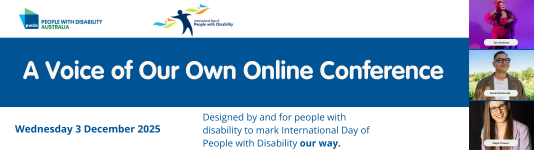
On Wednesday 3 December 2025, People with Disability Australia (PWDA) hosted A Voice of Our Own, its second International Day of People with Disability (IDPwD) national online conference created by and for people with disability.
The conference consisted of:
- Acknowledgement of Country
- Dr Alastair McEwin AM – 2 Years on from DRC
- PWDA Member Panel
- Ruth O’Brien –
- PWDA Board Director Steph Travers – Reflections from COSP
PWDA Acting CEO Megan Spindler-Smith opened the conference, welcoming advocates, community leaders, artists and PWDA members from across the country to mark and celebrate IDPwD, our way.
Acknowledgement of Country – Daniel McDonald
An Acknowledgement of Country was delivered by PWDA member Daniel McDonald. Daniel, is a proud Gadigal and Wonnarua man, owner of Deadly Hand Talk and disability advocate.
Daniel shared a striking reflection on renewal and belonging, reminding participants:
Everyone is around you. You are never alone. Value the simplest of life’s pleasures. Find meaning in small things. And the magic in every experience. Start the new beginnings.
Interim PWDA President Daniel Flynn reinforced the importance of strengthening our community’s voice to ensure our experiences guide policy and systems change and championing a future where people with disability lead with pride and visibility and influence.
“We know our voices are strong, expert and diverse. Today we will use the opportunity of IDPwD to highlight some of the brilliant people in our community who are key to the advancement of advocacy in disability rights across Australia.”
Dr Alastair McEwin AM Pre-recorded Address
The conference featured a pre-recorded address from Dr Alastair McEwin AM, former Disability Discrimination Commissioner and Royal Commissioner. He described the mixed emotions felt two years after the Royal Commission’s final report.
There have been days where I’ve been somewhat optimistic about progress from that final report and there have been days when I have been in despair and felt like things aren’t progressing at all.
Despite frustrations, he expressed enduring hope rooted in the thousands of disabled people who contributed to the Commission.
“When I have those days of despair I go back to the final report and remind myself that thousands of disabled people poured their heart and soul into providing information and evidence to the Royal Commission. I remind myself that we have a very comprehensive outline of what disabled people told us about the massive failings of mainstream setting to include them.”
PWDA Member Panel – Advancing and Advocating for Disability Rights.
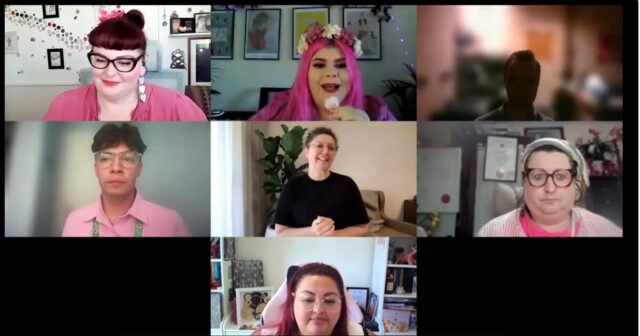
Next up in the conference was the PWDA member panel discussion on Advancing and Advocating for Disability Rights. Facilitated by Acting CEO Megan Spindler-Smith and featuring with Zoe Simmons, Ricki Spencer, Alexander Tofler, Tim Harte and newly elected PWDA Director Tahlia-Rose Vanissum.
The panelists shared their experiences in advocating for change, talked about ways to create fair and inclusive social policies, and discussed how our communities can work together. They also suggested steps we can take to help more people embrace “Nothing About Us, Without Us”.
Zoe Simmons shared how storytelling became her pathway, reminding us that every small action creates a ripple.
Ricki Spencer urged people to influence decisions in hospitals, councils and community services because “every voice counts.”
Alexander Tofler emphasised that lived experience itself is expertise.
Your story is evidence. Start with that and find your lane.
Tahlia-Rose shared their thoughts on how advocacy is grounded in cultural responsibility.
The moment you say ‘that harm is not normal,’ you are already an advocate.
Tim Harte reflected on acquiring disability at 19 and learning that advocacy is built on “persistence, solidarity and understanding the systemic context of our stories.”
Audience members also reflected in the chat their own advocacy journeys.
I am also extremely passionate about disability policy design and regulation and rights and committed to improving the lives of all individuals with disability. through sharing about my own disability journey and the barriers that I have faced throughout. I look forward to potentially connecting going forward.
My passion comes from my own lived experiences with systemic, organisational and societal failures along with surviving life with an incurable condition. My advocacy started with spreading awareness about hydrocephalus and brain injury. It has been amplified when I lost my job and recognised how important change in this area is. By no longer being silent but being vulnerable and speaking about it.
When discussing how to ensure all voices shape policy, the panel highlighted the need for meaningful co-design, structural reform and a refusal to accept tokenism. Alexander called for people with disability to be true partners in decision-making, while Tim highlighted the importance of removing participation barriers. Zoe emphasised the need to amplify marginalised voices, even when uncomfortable, and Ricki advocated for paid disability representation within local councils.
Looking ahead, Tim urged treating “Nothing About Us, Without Us” as non-negotiable, Tahlia-Rose highlighted the importance of making space for new leaders, and Zoe reminded us that public pressure is often what drives change.
You can complain a thousand times and nothing changes, until you make noise.
Ruth O’Brien – Disability, New Motherhood and Inaccessible Healthcare
Following the panel discussion, singer-songwriter Ruth O’Brien delivered a deeply moving presentation on disability, new motherhood, and the current inaccessibility of our healthcare systems.
…it wasn’t until I went outside my home that I felt disabled. It wasn’t because of me. Like I was fine. Because of all the things that I came into, had interactions with, whether that was people, whether that was physical things that weren’t accessible.”
Ruth urged greater inclusion of disabled parents in the design of baby products, health systems and support services.
Reflections from United Nations Conference of States Parties – Steph Travers
PWDA Board Director and Secretary, Steph Travers, shares reflections from attending the United Nations Conference of States Parties in New York earlier this year, highlighting how the personal stories shared there resonated most.
At the UN the stories that impacted me the most were not the big statements from national or international delegations. They were stories of individuals, local networks, not-for-profits and regional collectives who were driving change when national governments either can’t or won’t.
Steph also reflected that we often don’t discuss enough how deeply misinformed and disconnected the wider community is from the disability experience, emphasising the importance to allow people who aren’t disabled to hear our stories.
Steph then outlined four practical principles that we can all adopt to help share stories, foster allyship and promote greater inclusivity.
- Be a teacher. “We must all harness our inner teacher. Each story shared tells us how far we’ve come and also how far we have to go.”
- Facetime matters. “Words alone do not convey the complexity of our lives. People need to sit with us, hear us and witness the barriers we face.”
- Be a Karen. “Take up space and use your voice”.
- Stand together. “When one stands, we all stand.”
Full Speech from PWDA Board Director, Steph Travers
Due to time constraints Steph condensed her intended speech. Steph has provided the transcript of her full intended speech for our community to read:
My name is Steph Travers I’m a Board Director here at PWDA. I’m a 36‑year‑old Greek Italian woman with olive skin, long dark brown hair. Brown eyes and black glasses. I am speaking to you on the Sydney Central coast. I live with spina bifida, autism and psychosocial disability. I’m a disability legal advocate specialising in Social Security and guardianship proceedings, a bit of NDIS now and have been involved in disability rights and organisational governance for over a decade. I was asked to share some reflections from attending the UN Conference of State Parties in New York earlier this year.
At first I thought alright. I can walk through the CRPD, the articles, the legal protections we’re entitled to. When I sat with it I realised that is not what our community needs to hear today. What people need to hear is probably tangible actionable advice they can apply in their own life and don’t continue to be rolled back. The irony is that these two things overlap.
At the UN the stories that impacted me the most were not the big statements from national or international delegations. They were stories of individuals, local networks, not‑for‑profits and regional collectives who were driving change when national governments either can’t or won’t.
Great initiatives guided by co-led and designed by and for people with disability. I’ve been reflecting on this year’s international theme. Fostering disability inclusive societies for advancing social progressed. A mouthful. Especially the world fostering. I looked up the dictionary definition and it means to encourage the development of something, especially something desirable, like the teacher’s task is to foster learning. I would argue that the framework to foster inclusion already exists. We have a Disability Royal Commission that laid out the reform. We have the disability strategy with the CRPD provides the principles and the framework underneath. Governments and communities across Australia and around the world already have the tools they need to aim for that desirable end point. The part that we often forget is that the process isn’t linear.
There is no final end point. The biggest changes are often small and incremental. Just like a teacher fosters learning. People with disability foster inclusion. It is a process that will ebb and flow with peaks and troughs, ought to advance social progress. There is always an action and reaction. The year after the NDIS was introduced, they introduced a crackdown on DSP recipients under 35. And the impairment tables. There is a constant push and pull both national and international in all civil rights international progress.
However, sitting underneath all this is the reality that we don’t talk about enough. Which is how deeply misinformed and disconnected the wider community is from the disability experience. And I think today even though some of us even conflicted with today, is it a day for us to acknowledge that and allow people that aren’t disabled to hear our stories even if it is on a tokenistic level. It’s a way forward and way in. Today must not stand alone. So for reflecting today on what it mines to foster inclusion, I want to leave you with four principles, actionable principles.
Lesson 1, be a teacher. We must all harness our inner teacher. People with disability are inherently group problem solvers teachers with an inner resilience and good sense of moral responsibility. It is not some aspirational resilience for others to applaud. It just simply is.
I took a work at Parliament House domestic lived experience morning tea the other week. On the drive home he said Steph that is fascinating I live in a completely different world. He had learnt so much from being in the room. Just being exposed to stories, listening, it changed his perception. Each of us has a role to play in changing the perceptions of now the 500,000 support workers that work alongside of us. We also act as teachers to we cross paths with. Doctors nurses, teachers, principles, retailers, neighbours friends, family. Sometimes the way to change minds is through their hearts and eyes. Some of the best lessons I learnt at the UN were from individual story telling. Stories from Indigenous advocates in small villages, regional collective starting inclusive sports networks. Stories of forced sterilisation of new Gen X. Each story shared tells us how far we’ve come and also how far we have to go.
Lesson 2. Facetime matters. Always follow‑up with an action. In Facetime matters more than ever. Words alone do not convey the complexity of our lives. People need to sit with us, hear us and witness the barriers we face. The consequences of losing face‑to‑face interactions are clear in the NDIS and will likely get worse. We get planning processes that misunderstand what disability a person even has, we get plans with wrong names wrong disabilities, wrong impairments and fundamental misunderstanding of that person’s experience. When we lose connection, we most importantly we lose impact.
The lesson in this is also always follow‑up the digital with the physical. Follow‑up the conversation with an action. Make a point of difference to cut through the digital noise that keeps us invisible and at arm’s length from the people in the ivory tower. The biggest lesson I learnt at the UN was about capacity, the right to be heard and its relation to access to justice. And the interaction between visibility and change.
Lesson 3. Be a Karen. Take up space and use your voice. I say this with humour but also complete seriousness. Be loud. Use your review rights use every appeal pathway you have and don’t let people live rent free in your head during that process. Systems like the NDIS, DSP housing, education are designed in ways that let you down. Don’t let them. If your school isn’t inclusive lodge a discrimination complaint, if you can’t get into the building file a complaint. These pathways exist because international human rights logs guarantee your rights to access justice. In the ebb and flow of the inclusion process, while we advocate for positive rights that are yet to be given to us by the existing international law, review rights are essential to use and protect those rights.
Recently by psychologist just called me out on something. I said I just had a review and she goes, I said they cut some of my therapies I guess I should be grateful. So many people are worse off right now. She looked at me and said, Steph, your need doesn’t diminish because of your gratitude. That hit hard. Internalise ableism teaches us we shouldn’t ask too much. We should be thankful for whatever we get. Gratitude should not be the reason we accept less support than we need. Do not take less than you deserve and what a guaranteed to you by international law.
Some of the best work being done by ‑ is being done by nonprofits in the European court of human rights against guardianship practice. Strategic litigation spurred on by the courage of individual action, that is led to national and international reform in disability human rights.
The last lesson, lesson four when one stands we all stand. This brings me to the collective. And a phrase that I come back to frequently which is don’t criticise, organise. A peak body with a small policy team and nine board members cannot hold the entire disability landscape. It shouldn’t. This would replicate the old model where other people spoke for us and people at the top spoke for us.
The relationship is reciprocal, the paralysing all of you which one guiding the other, each giving feedback to the other. Collective power also requires coordination, among the peaks an among those in power, shared purpose and the willingness to take some risks. If they weren’t offer us a seat at the table in good faith we make our own. The CRPD demands meaningful disability led co‑design processes, not consultation as per lesson three, we should demand no less.
Co-design – if people with disability do not design the process itself, and are not embedded in the process from top to bottom, design to delivery, then it is merely consultation.
Right now, the NDIS budget line item has effectively become our quota across the board. This was no more obvious than in the budget process earlier this year.
Congratulations, people with disability – this is what your lives are worth.
And that is now framed as being “at the expense” of other areas of social investment, also whilst ignoring the entire ecosystem required for full inclusion of all PWD. What was a vein throughout my time in the UN, is that Australia is not unique in this shift. With increasing deficits and debt, in many places around the world, “inclusion” is now treated as a dirty word that suggests entitlement or a threat to others’ opportunities.
That comes from a fundamental misunderstanding of what inclusion actually is and why it is embedded in international law. It is not the raising of one cohort at the expense of another, but is simply providing the support for that cohort to reach parity.
So we must reframe the narrative. We cannot measure inclusion through the raw economics of providing a support. We must measure it against the cost of not providing it — the human cost, the social cost, the economic cost, and the cost to democracy and the social contract itself. This takes collective action and co-ordinated strategy.
I was heartened by the leadership shown by our young leaders at the United Nations and they deserve acknowledgement as they light the way and give optimism and hope to the next generation of leadership in our community. Alex Tofler, Tahlia-Rose Vincent, Tim, Ebe Ganon, Luke Nelson and others I surely haven’t mentioned.
And people with a disability should not participate in co‑design processes that will harm our community. There’s no safe way to roll out a harmful policy. Our collective voice must begin with one principle and one cohort identifies harm the rest of us do not deny or dismiss that harm. The most effective collectives internationally that I learnt are those with one coordinated strategic voice including the Commonwealth, Pacific and in Europe. And that practice begins locally. And so today I leave you with those four principles. Be a teacher, prioritise Facetime, be a Karen, take up space and stand together.
And that is how we turn this day from a day of symbolic tokenism into momentum and change. It is how we embed the CRPD, those lessons from the UN those desirable tenets that provide the roadmap, into an inclusive future for all Disabled Australians.
And remember over all else, in the ebb and flow and peaks and troughs in the fight towards inclusion, don’t let anyone steal your joy!
Event closing
To close the event, Interim President Daniel Flynn reaffirmed PWDA’s commitment to member-led advocacy and returned to the core message that real progress happens when people with disability lead it. “Nothing About Us, Without Us”.
Watch the recording
If you’re not a PWDA member, join for free here.
Ends | Contact us