The Australian Government agreed to a major package of disability and health reforms. Here is a brief outline of what we know so far.
Thursday 5 March
Early January 2026, the Australian Government agreed to a major package of disability and health reforms. These changes will affect how the NDIS works, who it supports, and the services that will sit alongside it.
In this blog we cover:
- What are the NDIS Reforms and why are they happening
- Three systems changing together
- What’s changing for the NDIS?
- Changes for children aged 0–8 (from January 2028)
- Why are governments doing this?
- What happens next?
- Therapy supports consultation underway
What are the NDIS reforms, and why are they happening?
The reforms will be rolled out gradually between 2026 and 2028, with some changes to continue beyond that.
We know that these changes can be confusing and cause a lot of fear and uncertainty about maintaining access to supports. Particularly, as many details remain unclear.
This blog outlines what we do know so far. We look at what is changing, why the government says it’s happening, and what to expect over the next few years.
At a high level, the government says the reforms aim to:
- Make sure people with permanent and significant disability continue to access the NDIS
- Build stronger non-NDIS supports for people with lower support needs
- Slow the long-term growth of the NDIS so it remains financially sustainable
- Shift more everyday supports back into mainstream and community services
This is designed to be a big structural change, not a quick tweak, and will happen in stages between 2026 and 2028.
Three systems changing together
Rather than changing the NDIS on its own, governments have linked three health-related reforms together:
- NDIS access and planning
- New ‘Foundational Supports’ outside the NDIS
- Extra funding for public hospitals and early childhood services
The idea is that people who don’t need long-term NDIS will still get timely, effective support through other systems.
What’s changing for the NDIS?
New framework planning (from July 2026)
From mid-2026, the NDIS will begin rolling out a new framework planning. This will change how plans are developed, with a transition period running through to 2030.
The government says this is about improving consistency and controlling costs, with a long-term goal of keeping NDIS growth to around 5–6% per year.
The new planning framework is built around four steps:
- preparing for a support needs assessment,
- the assessment itself,
- building the plan and budget,
- and using the plan.
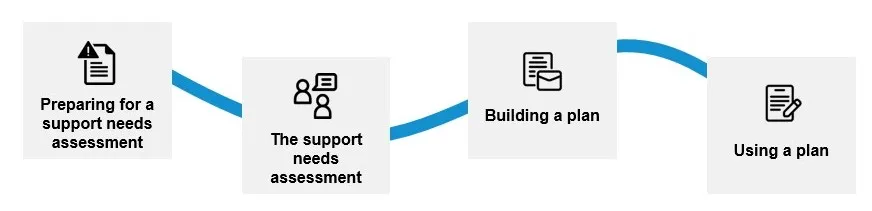
These steps aim to make the process clearer and more consistent for all participants.
The framework will be introduced gradually from mid-2026. A selection of participants over the age of 16 will be the first to transition to the new system.
Following the release of NDIS New Framework Planning consultation materials, PWDA undertook a member and community survey. Our submission to the consultation, closing Friday 6 March is grounded in what we heard from members and informed by our human rights framework.
How NDIS planning itself is changing
Alongside changes to NDIS access and new services outside the Scheme, the government is also introducing a new way of creating NDIS plans, under the new framework planning.
This is about how decisions are made, not just who can access the NDIS.
Under the new framework:
- Plans will be based more on a standard support needs assessment, rather than relying heavily on multiple reports
- The focus will be on a person’s day-to-day support needs, what works for them, and what is reasonable and necessary
- Budgets will be set using clearer and more consistent rules, which are intended to be more transparent.
The government says this approach is designed to make planning fairer, more consistent, and easier to understand across the Scheme.
How plan budgets will work under the new framework
Under the proposed changes, NDIS budgets would generally have two parts:
- Flexible funding, which can be used across a wide range of supports and is expected to apply to most everyday supports
- Stated supports funding, which must be used for specific supports listed in the plan, often for higher-cost or specialised items such as home modifications or complex equipment
Some limits or conditions may apply to protect participants or ensure essential supports remain available across the plan period.
Changes for children aged 0–8 (from January 2028)
The most significant change affects children aged 0–8 with developmental delay and/or autism with low to moderate support needs.
From 1 January 2028:
- These children will no longer automatically access NDIS Early Intervention
- Instead, they will be supported through new early childhood services outside the NDIS
Most importantly:
- Children already in the NDIS before 1 January 2028 will be assessed under the rules that applied at the end of 2027
- Children with permanent and significant disability or high support needs will continue to access the NDIS
What are “Foundational Supports”?
Foundational Supports are new, capped services designed to sit outside the NDIS.
Governments are committing $10 billion over five years, split evenly between the Commonwealth and the states.
These supports are intended to include:
- Early intervention
- Community-based supports
- Practical help that doesn’t require NDIS eligibility
States and territories will play a major role in delivering these services, with a rollout date yet to be confirmed, with full implementation stated to be by January 2028.
What is “Thriving Kids”?
Thriving Kids is a specific new initiative for children aged 0–8 with developmental delay and/or autism who have low to moderate support needs.
Key points:
- $4 billion promised over five years, shared equally between the Commonwealth and states
- Services will be delivered through a mix of Commonwealth and state programs
- Commonwealth and state services to begin no later than 1 October 2026
- Full national rollout by 1 January 2028, aligned with the NDIS access changes.
This program is designed to replace NDIS access for this group of children, rather than leaving families without support.
Why are governments doing this?
The government’s position is that the NDIS has grown faster than expected and needs to be more clearly focused on people with the highest needs.
They aim to reduce pressure on the NDIS while still meeting people’s support needs in other ways by investing in:
- early childhood supports
- community and mainstream services
- public hospitals and health systems
Whether this works in practice will depend heavily on:
- The quality and availability of Foundational Supports
- How well Thriving Kids services are designed and funded
- How smoothly families are supported through the transition
What happens next?
Over 2026 and 2027, Government has stated there will be:
- Ongoing consultation with the disability community
- New legislation to change NDIS access rules
- A gradual rollout of new services.
PWDA will continue to keep our community updated and continue to push for genuine codesign to ensure people with disability are involved in decision making and advocating to the government to ensure our community maintain access to the essential supports that they need to live.
Therapy supports consultation underway
The government is also consulting with allied health providers about how therapy supports (such as occupational therapy, speech pathology and physiotherapy) will be defined under the new planning framework.
These definitions will help determine how therapy is included in participant plans and budgets.
Further public consultation is expected in March 2026.
PWDA share a range of health and disability consultations in our Weekly Media Round Up and Monthly newsletter.
Or keep an eye on Australian Department of Health, Disability and Ageing Consultation Hub or NDIS Engage Hub.