Choices matter: why collecting more revenue is more efficient than cutting the NDIS Panel
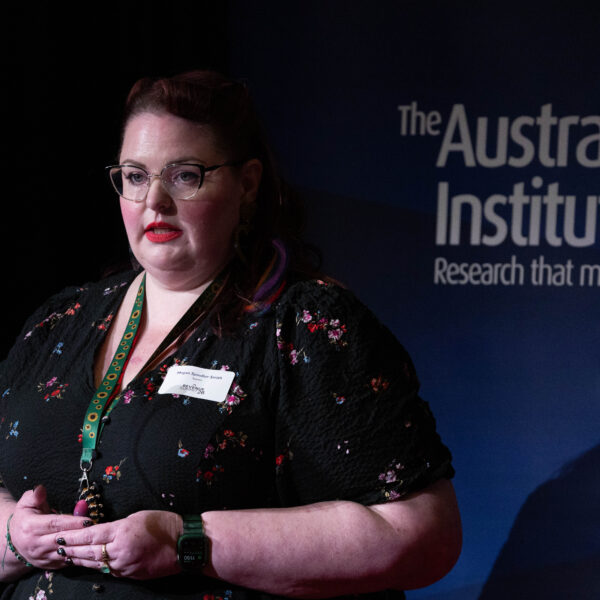
On Wednesday 14 October, PWDA CEO Megan Spindler-Smith gave a speech at the Australian Institute’s 2026 Revenue Summit on the panel Choices matter: why collecting more revenue is more efficient than cutting the NDIS alongside Muriel Cummins, President Occupational Therapy Society & Member of Every Australian Counts Steering Committee and Sophie Cusworth, CEO Women With Disabilities Australia.
Read the full transcript.
The Government has cut the NDIS.
The legislation has passed, the first reductions have begun, and people with disability will lose support they rely on to live their lives.
We’ve spent years debating what the NDIS costs. But somewhere along the way, we’ve lost sight of why Australia created it, that it brings $2.25 per dollar spent that it brings into the economy.
Before the NDIS, disability support was fragmented and underfunded. People waited years, families were pushed to breaking point, and access depended on your postcode or available funding.
People with disability were expected to make do, go without or rely on the unpaid labour of those who loved them. Unless you were lucky enough to be disabled and economically privileged.
Australia decided that wasn’t good enough. Yet these cuts risk taking us back there.
Because cutting funding doesn’t reduce the need for support.
The Australia Institute estimates these cuts could mean 94 million hours of paid support lost each year and around 52,000 jobs disappearing from disability and social assistance services.
Families and ageing carers may be forced out of work, alongside people with disability who lose the support they need to stay employed. These are the working people Treasurer Chalmers spoke about last night.
The consequences of these cuts will reach well beyond the NDIS, putting further pressure on already stretched state services.
In March, 328 people remained in NSW hospitals awaiting NDIS supports to be discharged. These cuts risk making that worse, particularly for people without informal support networks.
This comes as states face their own revenue challenges. NSW alone expects $5.3 billion less in stamp duty revenue over four years.
States and territories have made it unequivocally clear they cannot fill the gaps left by these cuts. Yet they’ll be left managing the consequences with less revenue than anticipated.
The Commonwealth may count these cuts as savings, but the costs don’t disappear. They’re shifted onto states, families and ultimately people with disability.
The Government has used NDIS expenditure, fraud and exploitation to justify these cuts.
We want fraud stamped out, providers held accountable and public money spent effectively. But cutting people’s support doesn’t achieve that.
Instead, the Government has fanned the flames of a deeply damaging public debate about the viability of people with disability to our community.
We’ve been portrayed as a burden on the public purse. Our needs questioned, our lives reduced to a cost, and our right to essential support treated as something people are entitled to debate.
As a disabled person, I can tell you what that feels like.
It feels like having your right to live safely, independently and with dignity treated as something I must prove I am worth having.
And I don’t accept that.
It’s not in the interests of people with disability, the public, or the Australia we claim to be.
Because there was a choice.
The Australia Institute estimates a 25 per cent tax on gas exports could raise almost $68 billion over four years, compared with around $35 billion in NDIS cuts.
Meanwhile, the mining industry is expected to receive $22 billion in fuel tax credits.
We could have addressed fraud and inefficiency while raising revenue to sustain essential supports.
Instead, the Government chose to cut the NDIS.
Australia is a wealthy country. We had choices about what we fund and what we expect people with disability to live without.
The question is not whether Australia can afford the NDIS. We can.
It’s why are we choosing to make people with disability pay for revenue we have chosen not to collect.
ENDS