PWDA members and community share their stories about Reasonable. Necessary and Ordinary ways the NDIS makes life possible
Monday 25 May
As part of our Reasonable. Necessary. Ordinary campaign we asked for your real life stories about “What does the NDIS make possible in your everyday life?“
These are the real life stories about what the NDIS funds.
How it supports people with disability to do ordinary things – like getting out of bed, going to work, eating, breathing and being part of our communities.
Members and community share what the NDIS makes possible for you!
The NDIS makes ordinary life possible for me.
by Taylah
Before I had access to the NDIS, I was attending the emergency department at least twice a week for years because the public health system alone could not meet my high psychosocial and neurological support needs. The NDIS has quite literally kept me alive, kept me safe, and reduced strain on the hospital system.
My disabilities are dynamic and fluctuate day to day.
Some days I cannot roll over in bed, stretch my fingers, lift a glass of water to my mouth, or sit upright unaided because of my neurological condition. Other days I experience intense suicidal thoughts and urges to self-harm, and it is only through trained support workers and behaviour support strategies that these episodes are safely managed before reaching crisis point.
Because of the NDIS, I can do ordinary things that many people take for granted — roll over in bed, use the toilet safely, eat meals, shower, attend appointments, leave the house, and participate in my community.
The NDIS supports me through both my neurological and psychosocial disabilities, including during periods where I am physically unable to care for myself or mentally unsafe on my own. Without these supports, I would be repeatedly hospitalised, isolated, and unsafe.
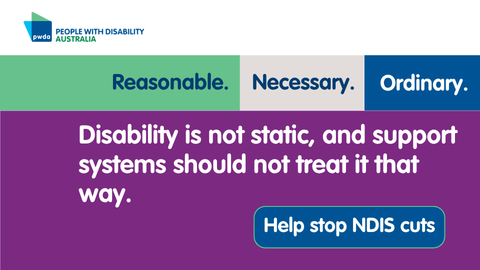
Disability is not static, and support systems should not treat it that way.
What the NDIS makes possible for the community
The NDIS helps me focus on managing one task when I get disorganised because of my conditions
Anonymous
Without the NDIS I wouldn’t be able to work and live connected
Because of the NDIS I can trust that the people who work with me are helping others thanks to the skills I learn and who help others
My daughter depends on support workers every day for her self care and being to go out in to the community. She is 26 and looking forward to moving into her own unit. If her NDIS funding is reduced or cut she will need to live at home forever. When the NDIS came about it was a great relief.. because I could see a future of self choice for Hanna. The same as her brothers have. The NDIS gave hope to my family that our lives would not always be taken up with caring for Hanna and we could have some normality. And relief that we can die peacefully with it being consumed with who was going to take over the role of caring for Hanna. We thought the NDIS would bring the peace knowing Hanna would have a choice of who she lived with and how she lived her life. And now I am again terrified that Hanna will have no choice. There has to be a better way of dealing with the economic crisis rather than slashing NDIS funding.
Anonymous
As someone with level 3 Autism, the NDIS is often the only way I get the supports that I need, for daily life, therapy, and even emergency care for when my disability is at its worst. As someone who doesn’t LOOK like I have level 3 Autism, someone who is high masking, or “High Functioning” as it’s often misleadingly labelled, I am one of those most at risk of losing these supports. Why should I have to perform my worst to be believed?
Anonymous
Because of NDIS supports I have been able to achieve and maintain mainstream employment. I work full-time and perform very well according to my employer.
Anonymous
My hospitalisations have reduced from 35+ admissions in a 6 year period to 0 admissions or presentations in the past 12months where I have been well supported by a range of NDIS clinicians – nurse practitioner, OT, psychologist and dietitian. My NDIS clinical needs have reduced now that I have purpose, routine and structure. Having a job helps me maintain my nutrition and daily routines.
I would like to continue working on being able to go to the zoo, a walk around the river, cook or get my groceries independently all the time. I am exceptionally grateful for my NDIS supports enabling me to gain and maintain employment. By the way, I pay a lot of tax.
The NDIS helps my family function. I am a disabled parent, and all three of my children are NDIS participants. Disability affects our everyday life – school, routines, regulation, communication, mobility, fatigue, appointments and community access. The NDIS helps us access therapy, equipment, assessments and support that make daily life more manageable. Without it, my children would be more isolated, misunderstood and unsupported. For us, the NDIS means dignity, safety, inclusion and a real chance to participate in ordinary life.
Anonymous
My daughter was born with Down Syndrome and congenital cataracts, she has a moderate intellectual disability and cannot access the community or the activities she loves to do without support. She does not have the capacity to travel independently and needs support for most of her activities. Having the NDIS to help her means that I can go to work part-time and be a productive part of society as a Registered Nurse, and that my husband can also work full-time and we can pay our taxes and support the economy that helps support us.
Anonymous
The NDIS helps my ASD intellectually disabled adult son to be able to live in a dignified, safe, caring, friendly environment away from home. It’s enabling him to make choices, encouraging and teaching him new life skills and providing for his physical, emotional and therapy needs. Being autistic, he is very routine orientated and copes very badly with many things including change. He needs help with all but the most basic tasks. The NDIS helps us to feel secure about our son’s future and opens up his horizons, to give him opportunities for fun, growth and improvement every day.
Anonymous
Without this support he would be lost.
Video stories
Take action
Your voice matters.
More stories
Stay up to date with all of our news and action.