PWDA delegation joins 19th Session of the Conference of States Parties to the UN CRPD (COSP19)
PWDA was on the ground last week along with other members of the Australian delegation including Government and civil society representatives at the United Nations Headquarters in New York for the 19th session of the Conference of States Parties to the CRPD (COSP19).
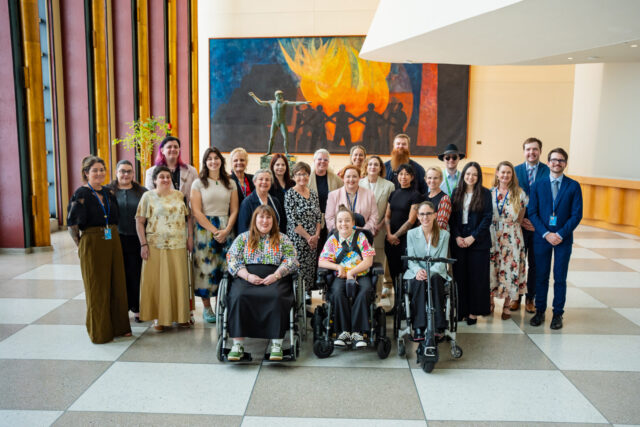
Photo: Members of the Australian delegation, including Government and civil society representatives, attending the 19th Session of the Conference of States Parties to the Convention on the Rights of Persons with Disabilities (COSP19). They appear in front of the mural painting, entitled “Brotherhood” (“La Fraternidad”) by Mexican artist Rufino Tamayo (1899 – 1991) at the General Assembly Building, United Nations Headquarters in New York.
Back row (left to right): Brooklin Mosen, William Ward-Boas, Lee-Anne Pringle, Rachel Logan, Bobbie Trower, Carly Wallace, Diana Piantedosi, Ramas McRae, Tim Harte, Julian Ladd
Middle row (left to right): Cassie Brophy, Helen Freris, Margherita Dall’Occo-Vaccaro, Kathleen McQuillan, Rhonda Faragher, Suzanne Muir, Cherry Baylosis, Jody Barney, Sophie Cusworth, Shelly Thomson, Alex Ladd
Front row (left to right): Rosie Putland, Claire Bertholli, Stephanie Travers
PWDA representatives Lee-Anne and Bobbie both gave powerful interventions at the event. An ‘intervention’ in this context refers to a formal statement delivered by a delegate during an ongoing debate or meeting.
Lee-Anne gave an intervention at the Civil Society Forum: ‘How can disability advocates and others support and respect the autonomy of people with disability?’
Bobbie gave their intervention at the (3rd meeting) of the General Debate: ‘How can we ensure that laws, policies and programs designed to implement the Convention do not deepen existing inequalities?’
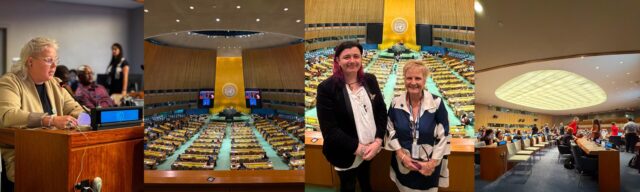
Intervention by Lee-Anne Pringle from Civil Society Forum under the auspices of the 19th Session of the Conference of States Parties to the UN CRPD (COSP19)
Transcript: My name is Lee-Anne Pringle, and I represent People with Disability Australia.
As Senior Manager for Individual Advocacy, working directly with people with disability, I see time and time again that people are excluded from decisions about their own lives, denied the dignity of risk, and denied the opportunity to practice decision-making skills.
I see this with young people with disability in child protection systems who transition directly into adult guardianship arrangements without meaningful and appropriate support to build decision-making capabilities, financial literacy, confidence or independence.
I see this in rural and remote First Nations communities in Australia, where people with disability under financial management arrangements can be denied access to small amounts of money for items that connect them directly to their culture, their identity and their community. I supported a First Nations person who could not afford to buy painting supplies for their Aboriginal artwork, so central to their identity, culture and wellbeing.
I have seen this in people with disability when they are assessed through the lens of risk, spoken about in meetings rather than spoken with, and excluded from decisions about where they live, how they spend their money, who supports them, or what goals they want for the future.
Too often, systems default to substitute decision-making. It is often framed as protection or safeguarding. One of the strongest safeguards we can offer is supporting people with disability to make their own choices, build confidence, and develop the skills to navigate adversity and stand up for themselves. People cannot develop these skills when decisions are made for them.
How can disability advocates and others support and respect the autonomy of people with disability?
First, we must uphold the dignity of risk. People with disability have the same right as anyone else to make everyday choices, take reasonable risks, make mistakes, learn from experience and grow.
Second, we must understand and respect the needs of people most impacted by overlapping systems of discrimination and inequality. This includes First Nations people with disability, women and girls with disability, people with disability of diverse sexual orientations, gender identities, gender expressions and sex characteristics, and people from national, ethnic, religious and linguistic minorities.
Advocates, providers and decision-makers must be trained and supported to understand, respect and promote the rights, needs and lived experiences of these communities.
If care and support systems are to promote genuine autonomy, they must stop treating control as protection.
Intervention by Bobbie Trower from (3rd meeting) 19th session of the Conference of States Parties to the Convention on the Rights of Persons with Disabilities (COSP19)
Transcript: My name is Bobbie Trower, and I’m here representing People with Disability Australia.
Twenty years after the Convention on the Rights of Persons with Disabilities, we’ve made critical progress in understanding that disability does not exist in isolation. Today, we benefit from decades of advocacy and lived experience leadership that have deepened our understanding of how disability intersects with gender, sexuality, race, culture, access to income and other identities to shape people’s experiences of exclusion and participation.
Unfortunately, despite some targeted efforts, many barriers remain for women, LGBTQI+ people, First Nations people and other people with disability experiencing multiple forms of discrimination. We continue to hear every day from people who struggle to access safe healthcare, inclusive services, community connection and supports that recognise the full complexity of their lives.
For the disabled LGBTQI+ community, these barriers are often compounded by discrimination, invisibility and systems that continue to treat our identities as separate rather than interconnected.
How can we ensure that laws, policies and programs designed to implement the Convention do not deepen existing inequalities?
The evidence is clear: when people with disability are involved from the beginning, and not simply consulted after decisions have been made, we see policies that are more effective, services that are more inclusive, and resources used more efficiently.
For those of us working at the intersections of disability, gender and sexuality, co-design is how we ensure that people who have been historically excluded are able to shape the decisions that affect their lives.
Looking towards the next 25 years of CRPD implementation, it must become more than a framework for aspiration and reporting. It must be an active mechanism driving tangible change for the disability community.
With ongoing humanitarian impacts, we must consider how the Convention can play a stronger role in ensuring accountability, action and investment in accessibility, inclusion and human rights.
A fully realised CRPD requires strong accountability, implementation and enforcement mechanisms that translate rights into action. Without them, we risk the next 20 years delivering too little progress, or worse, regression in the rights of people with disability.
As Australia currently undertakes significant disability reforms, including substantial cost-containment measures, and as countries around the world develop their own systems, efficiency can never come at the expense of equity.
The true success of any disability support system is not whether it works for the majority, but whether it works for those experiencing the greatest barriers.
Thank you, Madam Vice-President.
Ends | Contact Us