What we learnt from our online Pride event InFocus: Queer & Disabled
Tuesday 24 February
PWDA’s national online event InFocus: Queer & Disabled was held on Wednesday 18 February as part of our annual Pride campaign.
Bringing together a diverse audience of PWDA members, LGBTQIA+ people with disability and allies from across Australia to centre the voices, leadership and lived experience of LGBTQIA+ people with disability.
InFocus: Queer & Disabled was about creating a space for storytelling, connection and pride.
The collective message was clear: queer disabled people are leaders, creators and change-makers.
Watch the video or read the summary below.
Our Focus is Our Future – Margie McCumstie
PWDA member Margie McCumstie opened the event reflecting on the meaning of being ‘In Focus’ at a time of social and political uncertainty.
In sharing our experiences, our lived realities and our needs we shine a light on our community.
Margie spoke movingly about presence and authenticity, reminding participants that “focus forms our future, and it fuels our purpose.”
by staying present, listening and being authentic we can express what we want to achieve. We can create a better world for all, a world of light and a world of love.
“We’re here. We’re queer. We’re disabled. And we are in focus.” – PWDA Vice President Jarrod Sandell-Hay
PWDA Vice President Jarrod Sandell-Hay (FB) reinforced the power of intersectionality, stating: “Our disabled identity intersects with other parts of who we are, including our sexuality and gender…. They are not separate. They influence how we move through the world. ”
Jarrod affirmed that InFocus is more than a theme, it is a statement about moving from the margins to the centre.
It’s about being seen fully as queer and disabled people without having to separate the parts of ourselves.
It is about celebrating queer and disabled pride while creating space for authentic storytelling. He highlighted the power of connection and collective voice, affirming that our community is visible, united and not alone. “We’re here. We’re queer. We’re disabled.
What we know, what we live and what must change
LGBTIQA+ Project Lead Bobbie Trower shared insights from PWDA’s national survey of LGBTQIA+ people with disability, completed by 967 LGBTQIA+ people with disability.
Nearly two thirds of respondents stated they had experienced discrimination for being LGBTQIA+ and disabled.
Bobbie shared five focus areas identified in the survey data we need to work on togther to advocate for change.
- Believe Us – Respect and affirm LGBTQIA+ people with disability when we describe who we are, embedding belief into policy, training and service design.
- Design for the Intersection – Reform systems so disability, sexuality and gender are not treated separately, but addressed together through inclusive policies, integrated supports and cross-sector accountability.
- Economic Security is Inclusion – Strengthen income, housing and employment security, recognising that economic justice is foundational to safety, autonomy and authentic participation.
- Fund Peer Leadership – Invest in community-led spaces and lived-experience leadership that reduce isolation, build confidence and create safety through representation.
- Visibility Must Lead to Power – Move beyond tokenism by translating visibility into policy reform, funding, accountability and equitable access to services.
Together, these five areas shift the focus from acknowledging barriers to actively transforming the systems that create them.
In closing Bobbie shared a powerful quote from the survey “The hardest part of having both these identities is that the world wants to make you feel double‑broken. Even though these two identities make me double unique and it’s in my uniqueness that I have my power.”
Leaning into our collective queer crip power
PWDA member Jax Brown OAM, spoke about reclaiming the words queer and disabled as powerful, political identities that connect today’s community to a long legacy of activism and resistance.
Jax reflected on how the social model of disability transformed their understanding of exclusion and discrimination, helping them realise that systemic barriers, not their disability, were the problem. They highlighted how the model has played a central role in promoting disabled people’s individual self‑worth, collective identity and political power, and called on queer disabled communities to reject pressure to conform, embrace collective pride, and continue the anti-ableist struggle for justice and equal access.
This is anti‑ableist work and we’re building on a legacy of bold and proud queer disability activists and advocates who ask us not to conform, to not be quiet while queer disabled people continue to be discriminated against, abused, violated, stigmatised, denied access to the NDIS or underfunded or kicked off the scheme that we fought so very hard for.
Drawing on the words of Laura Hershey’s poem ‘You Get Proud by Practising’, Jax urged the community to reject internalised ableism
remember you weren’t the one who made you ashamed. But you are the one who can make you proud. Just practise. Practise until you get proud. And once you’re proud, keep practising so you won’t forget.
Laura Hershey
Jenna Hope and Jeramy Hope

In a pre-recorded message, PWDA member Jenna Hope shared some of their experiences and thoughts on what it is like being a young person who is both queer and disabled.
Jenna talked about wanting a future where queer and disabled people don’t feel the need to explain themselves all the time. Where safety isn’t something to be earnt and they are respected as they are.
I don’t want to choose which part of me people accept. I’m disabled. I’m asexual. And I’m still a whole person. Pride isn’t about being loud. It’s about not hiding.
Jenna’s father, PWDA president Jeramy Hope, reflected on allyship and leadership.
… leadership isn’t abstract. It is about creating environments where people feel safe to be themselves, it is about ensuring difference is met with respect and not resistance. These words we use in meetings, dignity, inclusion, opportunity, they carry weight because I have seen what happens when they’re absent and I’ve seen the power of what happens when they’re present. Being Jenna’s dad has strengthened my resolve, not from fear but from love. A belief that fairness matters, that community matters, that sometimes the most important leadership is simply standing beside someone and saying you belong.
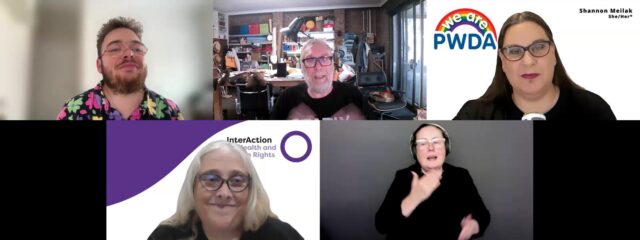
InFocus: Queer & Disabled PWDA member panel
The member panel was facilitated by Uncle Paul Constable-Calcott, a proud gay Wiradjuri man, polio survivor and respected human rights advocate who brings cultural leadership, storytelling and lived experience to his work.
As facilitator of the panel, Uncle Paul grounded the yarn in connection, recognition and pride, centring the voices of LGBTIQA+ sistergirl and brotherboys with disability, reminding everyone that queer disabled people are diverse, powerful and sexual beings, and that no single story represents the breadth of the community’s experiences.
“The role of storytelling and leadership by queer mob living with disability such as yourselves is driving the change and that change is slowly happening.”
Shannon Meilak spoke about showing up authentically explained that being both queer and disabled is not something she separates “both identities make up who I am.” And showing up authentically: “If I make them uncomfortable, good. It means I’ve hit a nerve.” She highlighted the importance of recognising disabled people as sexual beings and ensuring safe, inclusive spaces.
Shannon explained that being both queer and disabled is not something she separates “both identities make up who I am.” Shannon described showing up as her full self in every space, bringing an intersectional lens to her advocacy and daily.
We need to show up, we need to express who we are. We need to bring people along on that journey and let them stand a moment in our shoes, so to speak so they can greater understand what it is that we’re facing and what we’re actually wanting to achieve. Show them we’re just like them. We just walk through the world a little differently or roll through the world a little differently.
Dane Noonan spoke about how being queer and disabled is deeply connected to visibility, dignity and self-worth and how that experience has strengthened his resilience and self-advocacy. Dane described using humour, storytelling and openness to challenge assumptions and claim space across the communities he moves through.
My mission not only as an artist but a person who is queer and disabled is to encourage disabled people like us to find their voice. This world can be harsh but standing your power and keeping yourself is what we preach.