Resources and tips for the Inquiry into Securing the NDIS for the Future Bill 2026
The proposed National Disability Insurance Scheme Amendment (Securing the NDIS for Future Generations) Bill 2026 includes major changes to how people access the NDIS and receive supports.
Following an extension to reporting time, the Senate Standing Committees on Community Affairs has reopened submissions and adjusted the deadline for submissions.
You can now make a submission to the Senate Committee up until close of business Friday 10 July.
The proposed amendment document is more than 100 pages long and complex.
We know many members want to make a submission but might not be sure where to start. PWDA have provided a template and resources to support you through three (3) easy steps.
- Download the template
- Email your submission to the Community Affairs Committee
- Share your submission with us to inform PWDA’s future advocacy work
*PWDA encourages members to share their submissions with us to help inform our ongoing advocacy regarding the Bill and broader NDIS reforms. This helps us understand how many people have used the template to make a submission. If you are comfortable to do so, you can also give us permission to use deidentified information from your submission in our advocacy about the NDIS reforms.
PWDA Submission template
This template has been developed by PWDA to support our members and the disability community to make submissions to the inquiry into the National Disability Insurance Scheme Amendment (Securing the NDIS for Future Generations) Bill 2026.
The contents of this template do not represent PWDA’s final position on the Bill. PWDA’s submission is available on our submissions page.
This template is designed to help you structure your own views, experiences and concerns so you can participate in the inquiry process and be heard. Your submission does not need to be long or use formal language. Your experiences and concerns matter.
The template has been created with an instruction sheet to help guide you through the submission template .
Other useful resources
- Self Advocacy Resources Unit (SARU) have shared an Easy Read template
- Inclusion Australia – How to make a submission about the NDIS Bill Easy Read
- Inclusion Australia – What we think about the NDIS Bill
- Every Australian Counts – NDIS Bill Plain Language explainer
What is a parliamentary submission?
A parliamentary submission is a way to share your lived experience and concerns with the government when they are looking at an issue or making decisions.
Government often call an Inquiry into a Bill that is before Parliament. An Inquiry helps politicians understand the real life impacts of the law before voting on them.
If you want to have your say on an issue that a committee is looking into, you can share your experiences and ideas by writing to a committee – this is called making a submission.
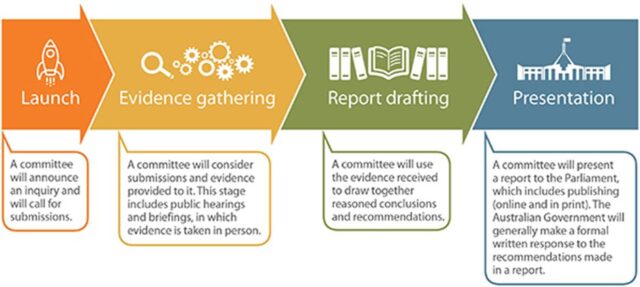
Government asks a question → Community shares feedback → Committee reviews feedback → Recommendations are made
General resources and links:
The Parliamentary of Australia and Parliamentary Education Office have a range of accessible resources to educate How Parliament works and assist Australians throughout the democratic process.
- How Committees work – Parliamentary Education Office
- Law making (includes visual representation of the path of a Bill) – Parliamentary Education Office
- Making a submission – Parliament of Australia, House of Representatives
- How to make a Senate Committee submission – Parliament of Australia
I never knew that we could make submissions. So mine needs to be considered. I have reported the NDIA to IBAC last month for fraud and money laundering. This is the reason why there is a cost blow out, because the NDIA are letting support workers and coordinators steal our money.
Hi Simone, the Inquiry has reopened submissions until Friday 10 July. There is still time if you would like to make a submission to the Inquiry. Thanks PWDA
I have made a YouTube video explaining reasons to end the NDIS cuts/how to support disabled people without cutting funds. I’ll write a shortened explanation here:
Parents/carers need to work reduced hours in order to drive their children to appointments and provide other support, which would therefore mean earning less money.
Individual impact: weekly therapy sessions without NDIS would be expensive. There would also be no access to disability-based social groups, making that person feel lonely. In addition, school students would be less successful in school (not just grades but also developing other skills like leadership skills and social participation).
Collective impact: schools would receive better grades, workplace productivity would increase if staff members had access to support. Less strain on systems such as emergency services and mental health crisis centres.
Reduce collective need for therapy: if schools integrated subjects/topics/activities into mainstream classroom for neurodivergent students to work on various skills, it would reduce the amount of therapy sessions needed and therefore collectively save money (it won’t be a complete replacement, but it would reduce the amount of NDIS funding needed)